

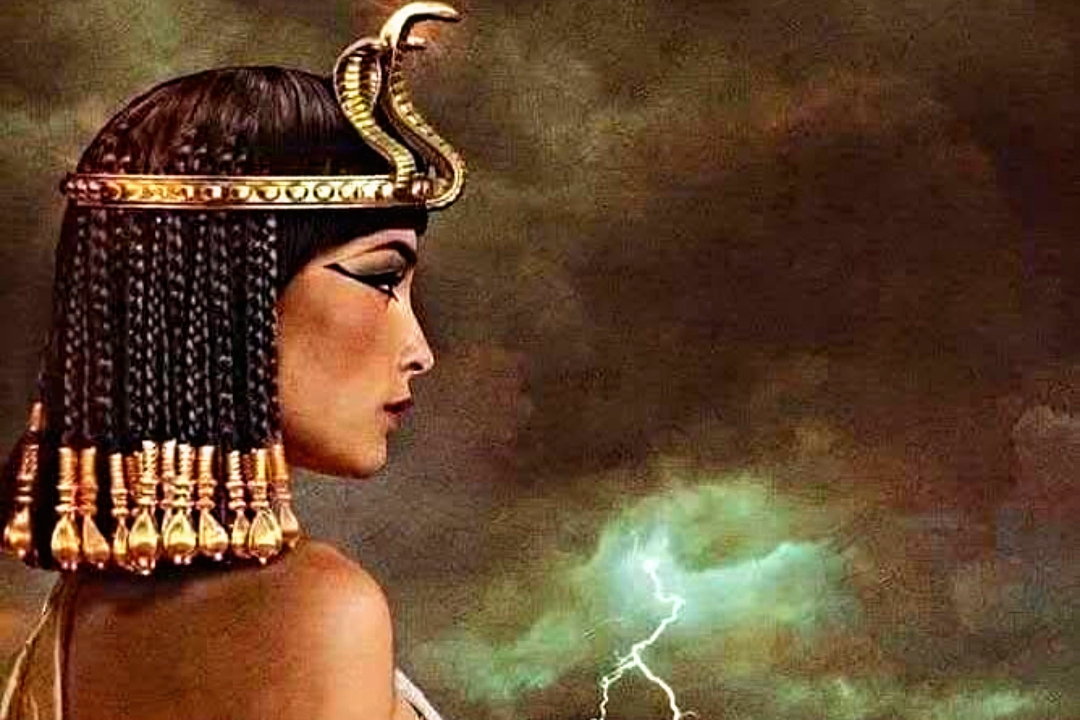

Cleopatra VII Philopator, more commonly known as Cleopatra, is one of the most iconic figures in history. Renowned for her intelligence, political acumen, and legendary charm, Cleopatra remains a subject of fascination for scholars and the public alike. She was the last active ruler of the Ptolemaic Kingdom of Egypt, a dynasty that traced its origins to Alexander the Great’s general, Ptolemy I Soter. Cleopatra’s reign and life were marked by political intrigue, love affairs with two of Rome’s most powerful leaders, and her dramatic death, which signaled the end of ancient Egypt as an independent power.
This article explores Cleopatra’s life, her relationships with Julius Caesar and Mark Antony, her role as a ruler, her death, and her enduring legacy. Through these lenses, we unravel the mystique surrounding Cleopatra, emphasizing her identity not merely as a seductive figure but as a shrewd and capable leader.
Cleopatra’s Early Life and Ascension to the Throne

Cleopatra was born in 69 BCE in Alexandria, the capital of Ptolemaic Egypt. She was a member of the Macedonian Greek Ptolemaic dynasty, which ruled Egypt after the conquests of Alexander the Great. Despite her Greek heritage, Cleopatra is often remembered as a symbol of ancient Egypt, a testament to her ability to embody and embrace Egyptian culture.
Unlike her predecessors, Cleopatra made a conscious effort to connect with her Egyptian subjects. She was the first Ptolemaic ruler to learn the Egyptian language, and she presented herself as the reincarnation of the goddess Isis, blending Greek and Egyptian traditions to solidify her legitimacy.
Cleopatra’s path to power was fraught with challenges. After the death of her father, Ptolemy XII, Cleopatra co-ruled with her younger brother, Ptolemy XIII. However, their reign was marred by conflict, culminating in Cleopatra’s exile. Determined to reclaim her throne, Cleopatra allied herself with Julius Caesar, a decision that would forever change her life and the fate of Egypt.
Cleopatra and Julius Caesar: A Political and Personal Alliance
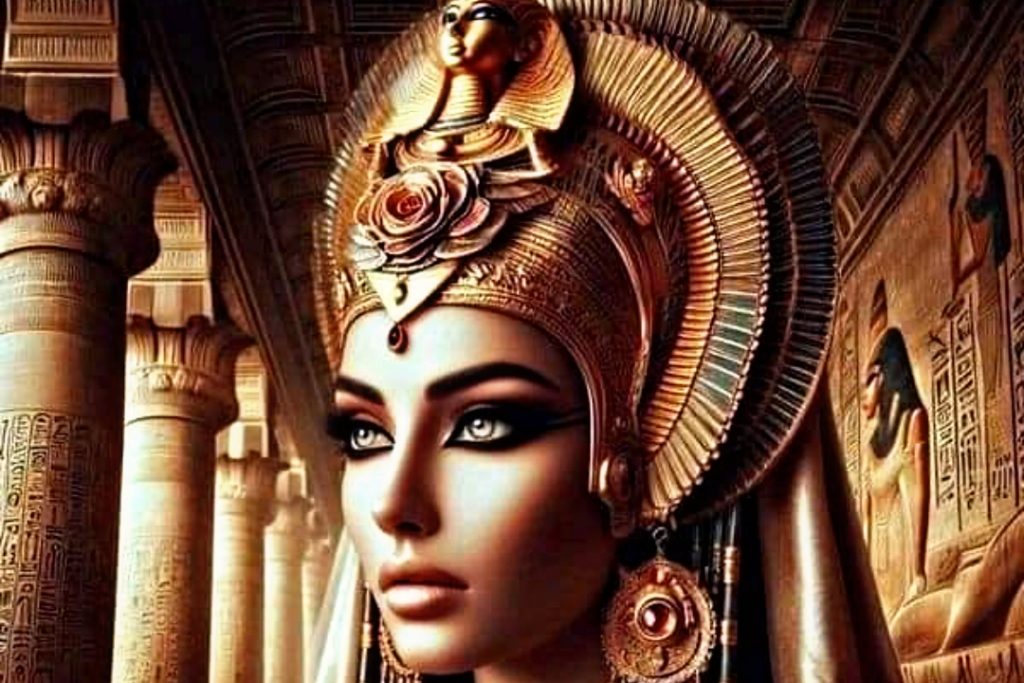
Cleopatra’s alliance with Julius Caesar was both political and personal. In 48 BCE, amidst her struggle for power with Ptolemy XIII, Cleopatra arranged a dramatic meeting with Caesar. According to legend, she had herself smuggled into his quarters rolled up in a carpet, a move that captivated the Roman leader and secured his support.
With Caesar’s military backing, Cleopatra defeated Ptolemy XIII and regained her throne. She became Caesar’s lover, and their relationship produced a son, Ptolemy XV, known as Caesarion. Cleopatra’s relationship with Caesar was strategic; it bolstered her position in Egypt and strengthened ties with Rome, the dominant power of the time.
Cleopatra visited Rome with Caesar, where she was both admired and reviled. To the Romans, she was an exotic and enigmatic figure, while her presence sparked political controversy. Caesar’s assassination in 44 BCE left Cleopatra in a precarious position, forcing her to navigate the shifting alliances of Roman politics.
Cleopatra and Mark Antony: Love and Power
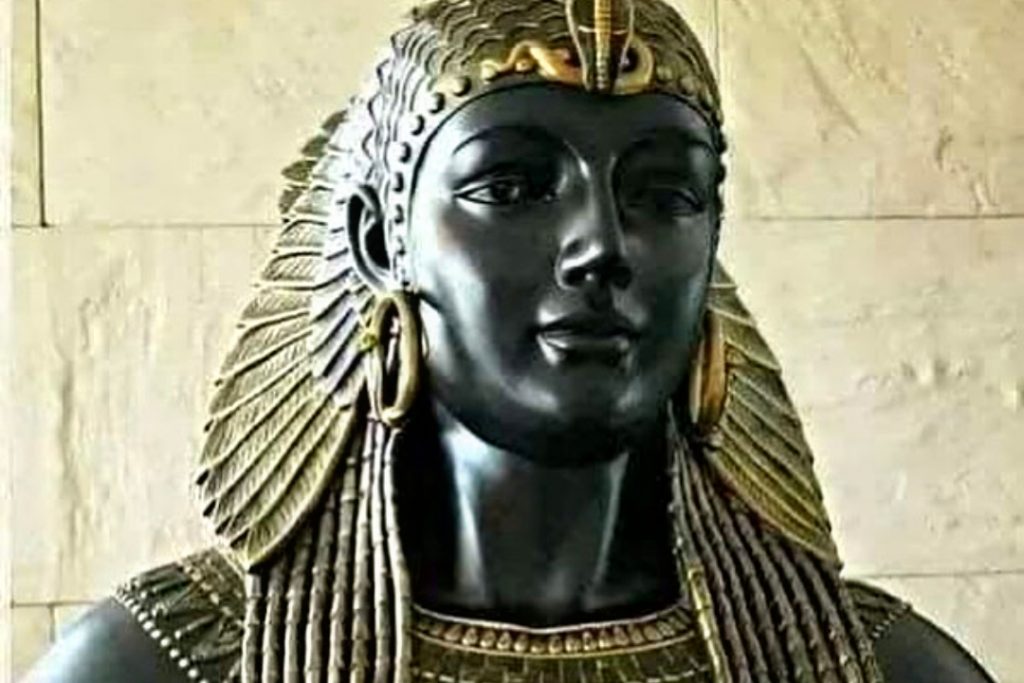
After Caesar’s death, Cleopatra returned to Egypt and focused on consolidating her rule. However, her fate became entwined with another Roman leader, Mark Antony. In 41 BCE, Cleopatra and Antony met in Tarsus, a moment famously romanticized by historians and artists. Cleopatra is said to have arrived on a golden barge, dressed as the goddess Aphrodite, captivating Antony with her intelligence, wit, and grandeur.
Their relationship quickly evolved into a powerful political alliance and a legendary love affair. Together, Cleopatra and Antony sought to challenge the authority of Octavian, Caesar’s adopted heir and the future Augustus. They formed a union that combined the military might of Antony with Cleopatra’s wealth and strategic resources.
The partnership between Cleopatra and Antony produced three children and a shared vision of establishing a Hellenistic empire. However, their ambitions put them on a collision course with Octavian, culminating in the Battle of Actium in 31 BCE.
The Battle of Actium and Cleopatra’s Downfall
The Battle of Actium was a decisive conflict that sealed Cleopatra’s fate. Octavian’s forces, led by his capable general Agrippa, defeated the combined fleets of Cleopatra and Antony. The battle marked a turning point, forcing the lovers to retreat to Egypt.
As Octavian advanced on Alexandria, Cleopatra and Antony faced the collapse of their power. Antony, believing Cleopatra had died, fell on his sword, only to discover she was still alive. Mortally wounded, he died in her arms, a tragic moment that has been immortalized in literature and art.
Cleopatra, determined to avoid the humiliation of being paraded as a captive in Octavian’s triumph, took her own life in August 30 BCE. According to popular accounts, she used an asp, a venomous snake, to end her life, though the exact method remains a subject of debate.
Cleopatra’s Legacy as a Ruler

While Cleopatra’s relationships with Caesar and Antony dominate popular narratives, her accomplishments as a ruler are equally significant. Cleopatra was a shrewd and capable leader who worked tirelessly to preserve Egypt’s independence in the face of Roman expansion. She implemented economic reforms, fostered trade, and sought to strengthen Egypt’s position as a cultural and political power.
Cleopatra’s ability to adapt and thrive in a male-dominated world is a testament to her intelligence and determination. She skillfully navigated the complexities of international diplomacy, balancing her role as a monarch with her personal ambitions.
Her reign marked the end of the Ptolemaic dynasty and the beginning of Roman rule in Egypt. Despite this, Cleopatra’s legacy endured, influencing perceptions of female power and leadership for centuries.
Cleopatra in Art, Literature, and Popular Culture
Cleopatra’s life and death have inspired countless works of art, literature, and film, solidifying her status as a cultural icon. From Shakespeare’s Antony and Cleopatra to the 1963 film Cleopatra starring Elizabeth Taylor, her story has been retold and reimagined, each interpretation adding to her mystique.
Cleopatra’s portrayal in popular culture often emphasizes her beauty and charm, but modern scholarship highlights her intelligence, political acumen, and cultural adaptability. She was not merely a seductress but a leader who sought to protect her kingdom and her people.
The Enduring Fascination with Cleopatra
The enduring fascination with Cleopatra stems from her multifaceted identity. She was a queen, a lover, a mother, and a symbol of resistance against imperial domination. Her life encapsulates the interplay of power, ambition, and human emotion, making her one of history’s most compelling figures.
Cleopatra’s ability to command the attention of the ancient world and her dramatic death have ensured her place in history. She remains a figure of intrigue and inspiration, representing the complexities of leadership and the resilience of the human spirit.
Conclusion
Cleopatra’s story is one of ambition, love, and resilience. As the last queen of ancient Egypt, she faced immense challenges but remained steadfast in her quest to secure her kingdom’s future. Her relationships with Julius Caesar and Mark Antony, while integral to her narrative, should not overshadow her achievements as a ruler and her impact on history.
The life and legacy of Cleopatra continue to captivate and inspire, serving as a testament to her enduring significance. Through her intelligence, charisma, and determination, Cleopatra has transcended time, leaving an indelible mark on the world’s collective imagination.